
Mining Investor Communication Guide
Helping Investors Understand Your Company’s Story
Mining and exploration companies operate in one of the most technically complex sectors of the market. While ASX announcements provide critical information to shareholders, they often contain specialised terminology, technical data, and regulatory disclosures that can be difficult for many investors to interpret.
Effective investor communication is not about simplifying the facts. It is about making information accessible, understandable, and engaging while maintaining accuracy and compliance.
This guide outlines best practices for improving investor understanding, strengthening shareholder engagement, and ensuring investors can easily follow your company’s progress over time.
Why Investor Communication Matters
Investors make decisions based on information.
When information is difficult to understand, investors may:
- Miss the significance of important developments
- Misinterpret technical results
- Lose engagement with the company
- Seek information from less reliable sources
- Look elsewhere for investment opportunities
Companies that communicate clearly often benefit from:
- Greater investor confidence
- Improved shareholder engagement
- Increased website activity
- Better understanding of company milestones
- Stronger relationships with existing investors
- Improved visibility among prospective investors
Investor communication is not just about meeting disclosure obligations—it is about helping investors understand the value of what your company is achieving.
The Challenge With Mining Announcements
Mining announcements frequently contain:
- Geological terminology
- Resource estimates
- Drilling data
- Metallurgical information
- Technical studies
- Regulatory disclosures
- Corporate and funding updates
While these announcements are essential, many investors do not have technical mining backgrounds.
A geologist, mining engineer, or exploration manager may immediately understand the significance of a result. Retail investors and prospective shareholders often do not.
This creates a communication gap between technical disclosure and investor understanding.
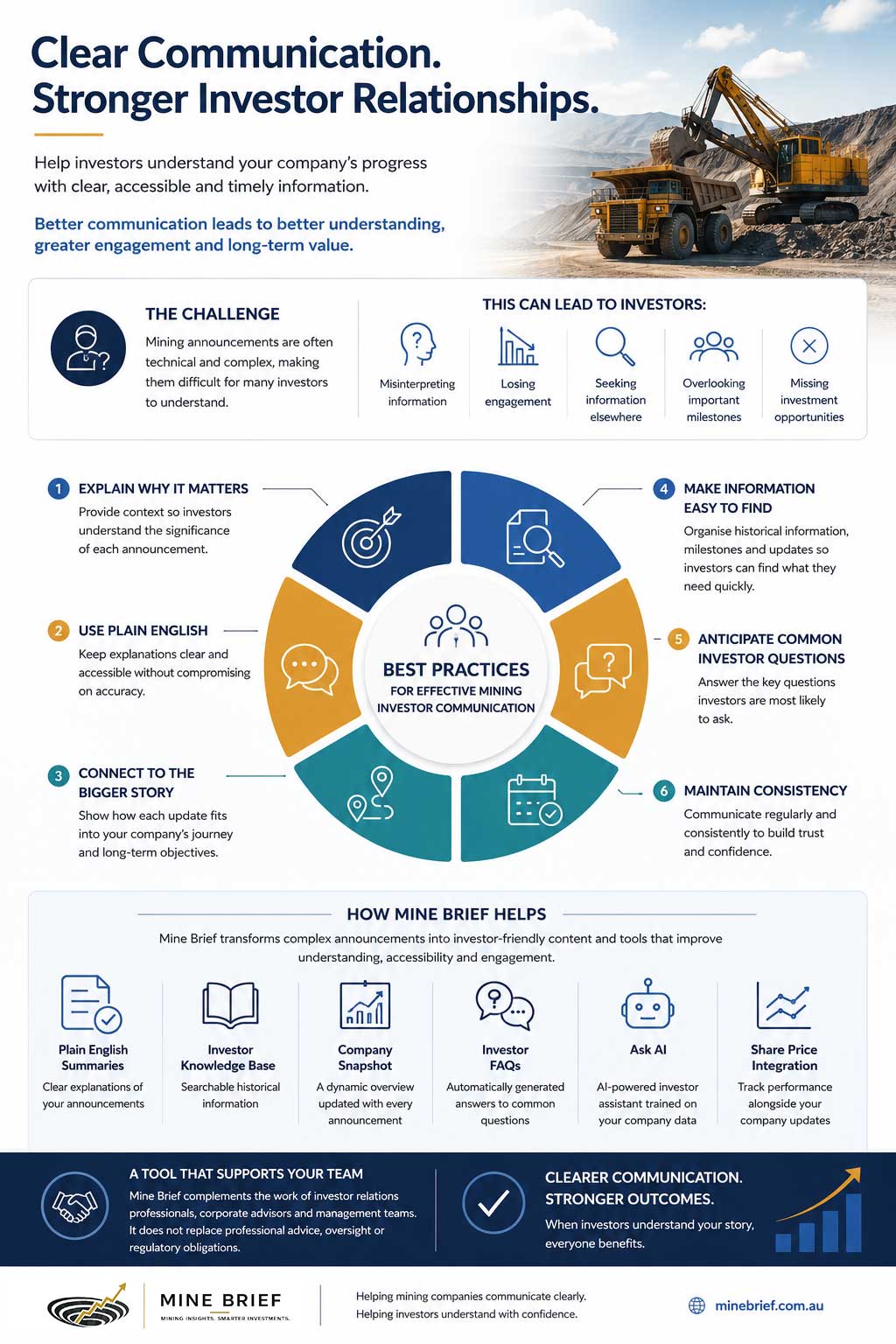
Best Practice 1: Explain Why It Matters
Many announcements describe what happened.
Fewer explain why it matters.
Investors are often asking questions such as:
- Is this good news or bad news?
- What impact could this have on the project?
- What does this mean for future development?
- What happens next?
- Why is this announcement significant?
Providing context helps investors understand the importance of an announcement without changing or embellishing the underlying facts.
Best Practice 2: Use Plain English Where Possible
Technical information should remain technically accurate.
However, supporting content can often be written in a way that is easier for investors to understand.
For example:
Instead of relying solely on technical terminology, consider explaining:
- What a resource upgrade means
- Why drilling results are significant
- The purpose of a scoping or feasibility study
- How funding may support future development
- What project milestones have been achieved
Clear communication improves accessibility without compromising accuracy.
Best Practice 3: Connect Announcements To The Bigger Story
Investors rarely evaluate announcements in isolation.
They want to understand:
- Where the company has come from
- What progress has been made
- What milestones have been achieved
- What objectives remain ahead
When announcements are presented within the broader context of a company’s development journey, investors can more easily understand the significance of individual updates.
This is particularly important for exploration and development companies where value is often created over many years.
Best Practice 4: Make Historical Information Easy To Find
Many investors begin researching a company months or years after important announcements were released.
Unfortunately, information is often spread across large archives of PDF documents.
Providing access to:
- Historical announcements
- Project milestones
- Company snapshots
- Frequently asked questions
- Searchable company information
can significantly improve the investor research experience.
Investors who can quickly find information are more likely to remain engaged with the company.
Best Practice 5: Anticipate Common Investor Questions
Investors frequently ask similar questions, including:
- What projects does the company own?
- What stage of development is the project in?
- What were the latest drilling results?
- What funding has recently been completed?
- What milestones have been achieved?
- What are the company’s next objectives?
Providing answers to common questions helps reduce information barriers and improves investor understanding.
Best Practice 6: Maintain Consistency
Consistent communication builds trust.
Investors should be able to easily follow:
- New announcements
- Project developments
- Corporate activities
- Funding updates
- Strategic milestones
A structured and consistent communication approach helps shareholders remain informed and engaged throughout the company’s growth journey.
The Role of Technology in Modern Investor Communications
Investor expectations continue to evolve.
Today’s investors expect:
- Faster access to information
- Mobile-friendly experiences
- Searchable content
- Easy-to-understand explanations
- Immediate answers to common questions
Technology can help companies improve accessibility and investor engagement without replacing existing investor relations processes.
Tools such as investor knowledge bases, announcement summaries, FAQs, and AI-powered search capabilities can help investors find and understand information more efficiently.
Supporting Investor Relations Teams
Strong investor communication remains a collaborative effort involving management, company secretaries, investor relations professionals, communications specialists, and external advisors.
Technology should support these activities—not replace them.
The goal is to help companies communicate more effectively while maintaining appropriate oversight, governance, compliance, and professional advice.
How Mine Brief Supports Investor Communication
Mine Brief is designed to complement existing investor relations and corporate communications activities by helping mining companies present information in a format that is easier for investors to understand.
Mine Brief helps companies:
- Generate investor-friendly announcement summaries
- Build searchable investor knowledge bases
- Create dynamic company snapshots
- Generate investor FAQs
- Provide AI-powered investor search tools
- Improve website engagement
- Help investors access information more easily
Importantly, Mine Brief does not replace investor relations professionals, legal advisers, company secretaries, or regulatory obligations. It is designed to support existing communication processes and improve investor understanding.
Conclusion
Investors are more likely to engage with companies when information is accessible, understandable, and easy to find.
By focusing on clarity, context, consistency, and accessibility, mining companies can strengthen investor relationships, improve transparency, and help shareholders better understand their investment story.
As investor expectations continue to evolve, companies that prioritise effective communication will be better positioned to attract, engage, and retain investors over the long term.
Ready to Improve Investor Communication?
Discover how Mine Brief can help transform technical mining announcements into investor-friendly content, knowledge bases, company snapshots, FAQs, and AI-powered investor insights.
Start your 14-day free trial today and see how easy it is to improve investor understanding and engagement.